I was sitting across from a Sales Director at a manufacturing business in the Midlands. Good business. Growing. Ambitious. But he had a problem he couldn't solve with effort alone.
"My team works hard," he said. "Nobody's coasting. But we're not converting fast enough and I can't work out why."
I asked him to walk me through a typical day for one of his reps.
It went something like this: arrive, check emails, open LinkedIn, start searching for companies that might be a fit, check their website, check Companies House to see if they're the right size, look for a contact name, find an email, log it into CRM, and then, finally, start thinking about what to say.
By the time the rep had done that for three or four prospects, it was lunchtime.
Half the selling day gone. Not on selling. On finding people to sell to.
I asked how many hours a week his reps spent on this kind of research.
"Probably ten. Maybe more."
I did the maths with him.
Five reps. Ten hours each. At an average fully loaded cost of £25 per hour.
That's £1,250 a week. £65,000 a year. Spent on research, not revenue.
He went quiet. He'd never calculated it before. Nobody does. It's one of those costs that hides in plain sight, baked into the daily rhythm of every sales team that prospects manually.

The Problem Nobody Measures
This is the conversation that led us to build the Lean Learning Collective Lead Accelerator. Because what we kept finding, across manufacturing, distribution, construction, professional services, and dozens of other B2B sectors, was the same hidden waste.
Sales teams aren't underperforming because they can't sell. They're underperforming because the starting point of every outbound cycle is broken.
Reps are building their own target lists. Manually. From LinkedIn searches, guesswork, two-year-old CRM data, and the occasional bought list that turns out to be 40% dead emails. The quality is inconsistent. The process is different from rep to rep. The criteria shift depending on who's building the list and how much time they have.
And that creates three serious downstream problems.
Problem one: the Sales Manager can't diagnose performance. When a rep misses target, was it their selling skills or their targeting? If the starting list was weak, nobody can tell. Coaching becomes subjective. Accountability gets soft. Forecast confidence drops.
Problem two: the CFO can't justify the sales headcount. When the conversation turns to "what are we getting for our sales wage bill?", the honest answer is that a significant chunk of paid selling time is going into research activity that never appears on a pipeline report.
Problem three: leadership can't trust the pipeline story. Every month, the CEO asks "where's the next wave of business coming from?" and the Sales Director has to answer with some variation of "we're working hard on outreach." That's not a strategy. That's a hope.
What Changes When You Fix the Starting Point
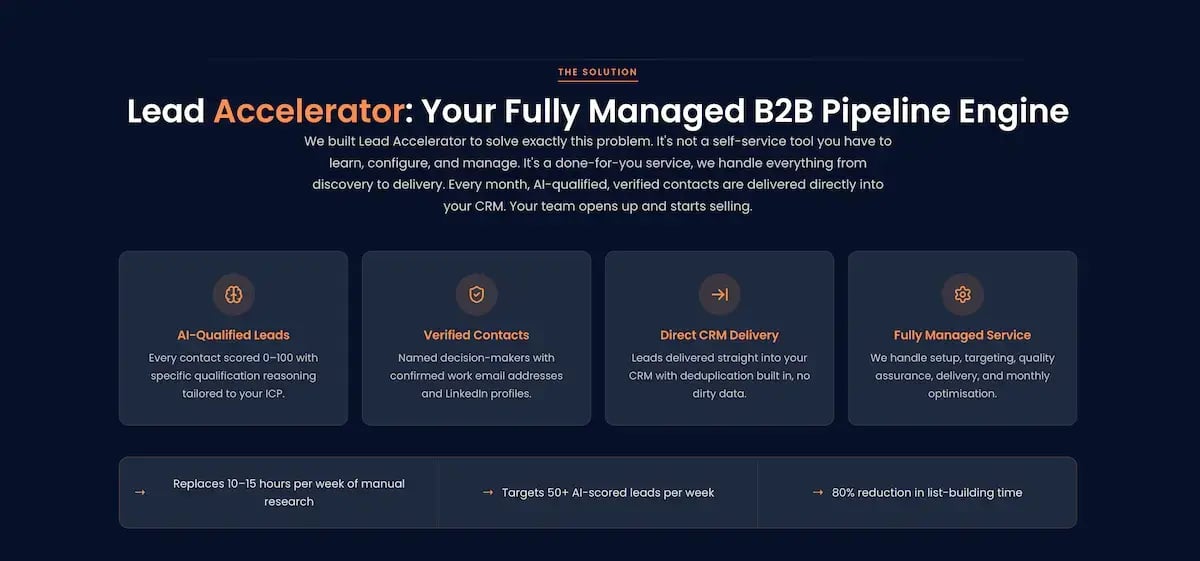
The Lead Accelerator is a fully managed service not a software subscription, not a database login, not a tool your team has to learn. It's a "done for you" system that delivers qualified, scored, prioritised target accounts directly into your CRM every month.
Here's how it works.
Step 1: Configure. We define your Ideal Client Profile together. Industry, size, geography, SIC codes, specific qualification criteria. This becomes the filter that everything runs through.
Step 2: Source. Our system pulls companies from Companies House and sector-specific databases real, verified, registered UK businesses. Not scraped data from LinkedIn. Not recycled lists from data brokers. Primary source data.
Step 3: AI Qualify. Every company is scored by an AI qualification engine powered by Google Gemini. It checks the company against your fit criteria, assesses likelihood of need, and assigns a priority score. Companies that don't pass are rejected. In our pilot testing, the AI qualification rate was 91.3% meaning it correctly identified fit at a rate that would take a human researcher hours to replicate.
Step 4: Enrich. For every qualified company, we find named contacts using email verification software, verified email addresses, job titles, and LinkedIn profiles for decision-makers. Not generic "info@" addresses. Real people your reps can reach.
Step 5: Deliver. Qualified, scored, enriched leads are pushed directly into your CRM. Tagged, lifecycle-staged, and ready to work. Your reps open CRM on Monday morning and see a prioritised list of companies they should be calling, with a reason for each one.
The entire process runs on automation. No manual research. No list-building. No guesswork.
What the Numbers Actually Look Like
When we piloted the Lead Accelerator with our first client, the results surprised even us.
The client was testing it on their weakest sales territory, the patch that had consistently underperformed for two years.
In the first cycle, the Lead Accelerator delivered a 200% increase in qualified leads compared to the reps' manual prospecting. The AI qualification engine processed hundreds of companies and achieved a 4.9% conversion rate from lead to opportunity, nearly five times the industry average for cold outbound.
But the stat that mattered most to the Sales Director wasn't the lead volume. It was this: each rep got back 10+ hours a week that had previously been consumed by research. That time was immediately redeployed into actual conversations, follow-ups, and closing.
The prospecting bottleneck didn't just ease. It disappeared.
Why This Matters for Sales Managers
If you manage a sales team, you live between two kinds of pressure. From above, the CEO and CFO want numbers, confidence, and pipeline visibility. From below, the team wants better targets, better support, and less wasted effort.
The Lead Accelerator helps you answer both.
Upward, you can say: "We have a structured, AI-scored target account process. Our reps are working the highest-fit accounts first. We've eliminated manual list-building and redirected that time into selling."
Downward, you can say: "Here's your shortlist. Here's why these accounts matter. Here's where to start."
That's a different management conversation. That's a different pipeline meeting. That's a different business.
Your team stops being researchers. Your coaching gets sharper because you've removed the "the list was bad" variable. Your forecast gets more credible because the input quality is consistent. And your CFO sees a sales wage bill that's actually working, reps selling, not searching.
How It Compares to What You're Probably Doing Now
Most B2B sales teams solve the prospecting problem in one of three ways, and all three have significant limitations.
Option 1: Manual prospecting by reps. The cheapest option upfront, but the most expensive when you account for the hidden salary cost. A team of five reps spending 10 hours a week on research represents £50,000+ per year of misdirected wages. The quality is inconsistent. The process isn't repeatable. And the manager has no visibility on targeting strategy.
Option 2: Buying data lists. Platforms like ZoomInfo (from £12,000/year), Cognism (£20,000–£36,000/year), or Apollo charge per seat and give your team access to a pre-built database. The problem is that the data is often generic, the same contacts your competitors are buying and the qualification still falls on your team. You're paying for access to raw data, not for qualified leads.
Option 3: Hiring an SDR or BDR. The average SDR salary in the UK is £28,000–£35,000 plus commission, on costs, management time, and training. A single SDR might produce 20–30 qualified leads per month after a 3-month ramp up period. That's an effective cost of £100–£200+ per qualified lead.
The Lead Accelerator costs a fraction of all three. The setup is a one-off investment, and qualified leads are delivered at a figure that typically represents a 50–100x reduction compared to the effective cost of manual prospecting or SDR generated leads.
There are no per-seat fees. No annual licence. No database subscription. You pay for the setup, you pay per qualified lead, and you get a fully managed service that runs every month without your team lifting a finger on the prospecting side.
Who This Is Built For
The Lead Accelerator works for any B2B business that sells to other UK companies and needs a steady flow of qualified prospects. We've built it for manufacturing, distribution, construction services, professional services, and technology companies but the model works for any sector where your Ideal Client Profile can be defined by company size, location, industry, and role.
It's particularly effective for businesses that are trying to break into a new market or territory. Instead of losing the first quarter to research while reps scramble to understand a new sector, the Lead Accelerator delivers a scored, prioritised target list in week two. One client used it to book more first meetings in 90 days in a brand-new vertical than their existing territory had delivered in six months.
This Is What the Lean Learning Collective Does
The Lead Accelerator sits at the heart of a broader philosophy at the Lean Learning Collective. We find the waste in your business, whether it's in email processing, SDS document transfer, CRM data quality, or sales prospecting and we build AI-powered solutions that eliminate it permanently.
We don't sell software. We don't offer generic advice. We build bespoke, measured, practical solutions that give your team back the hours they're currently losing to work that shouldn't exist.
Whether it's doubling factory output through lean + AI programmes, cutting email time by 60% with Microsoft Copilot, automating Safety Data Sheet transfers with SmartSDS, or cleaning your HubSpot CRM with SmartClean the Lean Learning Collective approach is always the same: find the waste, build the automation, measure the result.
The Lead Accelerator is simply what that looks like when the waste is hiding in your sales team's prospecting process.
Want to See What Your Target Account Report Would Look Like?
We'll build a sample target account report for your specific ICP, your industry, your geography, your fit criteria, so you can see exactly what your reps would be working from.
No cost. No obligation. Just a real example using your actual market.
Book a free 15-minute discovery call →
Contact us and tell us your sector, lets see how we can free up your Sales Team's time.