Picture this: It is 2:00 AM on a Tuesday. Your primary bottling line grinds to a halt. The stack light flashes red, the SCADA screen throws up a cryptic “Error Code 505: Servo Sync Failure,” and your shift lead is frantically flipping through a paper manual that hasn’t been updated since 2019. Every minute this line sits idle, you are losing cases, bleeding money, and risking a missed shipment window.
This is the reality for too many FMCG teams. They do not struggle with a lack of data; they struggle with "slow diagnosis". The gap between the machine fault occurring and the technician understanding the root cause is where efficiency goes to die. But what if that gap didn’t exist? What if you could say, “Show me the machine fault,” and an "automated machine fault workflow" showed you exactly how to fix it in under 30 seconds?
In this article, you will learn:
What an automated machine fault workflow is and why it is the future of maintenance.
How Leana AI Detective works to translate raw data into plain-language fixes.
Why FMCG teams struggle with traditional diagnosis methods.
Step-by-step instructions to build your first diagnosis workflow.
Real-world examples of reducing Mean Time to Repair (MTTR).
What Is an Automated Machine Fault Workflow?
An automated machine fault workflow is a digital process that instantly detects equipment anomalies, analyzes the root cause using historical data and AI, and pushes a specific, actionable solution to the operator’s device. Instead of a technician arriving to investigate what happened, the system informs them why it happened and how to fix it before they even reach the machine.
The Shift from Reactive to Prescriptive
Traditionally, maintenance is reactive. A machine breaks, a human investigates, and eventually, a fix is applied. This manual investigation phase is the biggest consumer of time in the breakdown cycle. An automated workflow removes the investigation phase entirely.
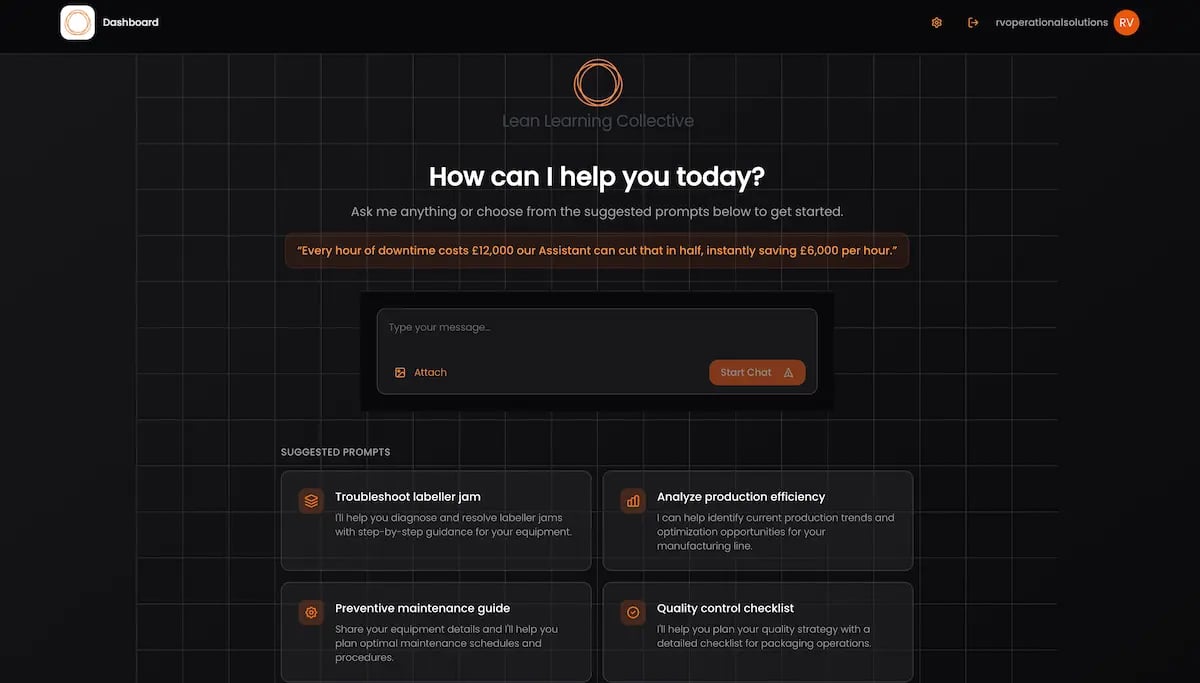
By integrating tools like Leana AI Detective, the system acts as a translator. It takes the raw dialect of the machine, vibration spikes, temperature deviations, logic controller codes and converts it into the language of your workforce. It doesn't just say "Motor Fault"; it says, "Motor B Overheat likely caused by debris in Intake Fan. Clean intake fan to resolve."
The "30-Second" Standard
The "30-second" benchmark isn't just a catchy phrase; it is a critical operational KPI. In high-speed FMCG environments, micro-stops (stops under 5 minutes) often account for 50% or more of total downtime. If it takes 10 minutes to diagnose a fault that takes 2 minutes to fix, your efficiency is plummeting.
Key characteristics of this workflow include:
Instant Trigger: The workflow starts the millisecond a fault code is registered.
Contextual Data: It pulls historical data to see if this fault has happened before.
Probability Ranking: It suggests the most likely fix based on past success rates.
Multimedia Support: It provides images or one-point lessons (OPLs) directly to the HMI or tablet.
Why Do FMCG Teams Struggle with Slow Diagnosis?
FMCG teams struggle with slow diagnosis because their troubleshooting knowledge is often siloed in the heads of a few veteran technicians rather than embedded in the system itself. When those experts are off-shift or retire, the "tribal knowledge" leaves with them, leaving the remaining team to guess at solutions while the clock ticks.
The "Data Rich, Insight Poor" Paradox
Modern manufacturing lines generate terabytes of data. However, according to recent industry reports from the UK and Australia, many manufacturers utilize less than 10% of the data they collect effectively.
Operators are bombarded with alarms. A single downstream blockage might trigger five different sensors upstream, causing a "cascade" of fault codes. Without an automated machine fault workflow, the operator has to mentally filter this noise to find the signal. This cognitive load leads to decision fatigue and, inevitably, longer downtime.
The Skills Gap Crisis
The manufacturing sector in the UK and Australia is currently facing a severe skills shortage. A 2024 report by Make UK highlights that the departure of experienced staff is one of the biggest risks to productivity.
When you rely on human experience alone for diagnosis, you are vulnerable. New technicians simply do not have the pattern-recognition skills that a 20-year veteran possesses. Automated workflows bridge this gap by digitizing that experience. Lean Learning Collective's Leana AI Detective essentially "clones" the knowledge of your best engineer and makes it available to everyone, 24/7.
Common diagnostic bottlenecks:
Ambiguous Error Codes: "General Fault 101" gives no direction.
Shift Handovers: Information about recurring issues is lost between shifts.
Paper Manuals: Searching through physical binders is too slow for high-speed lines.
Lack of Standardisation: Shift A fixes a jam differently than Shift B.
How Does Leana AI Detective Reduce MTTR?
Leana AI Detective reduces Mean Time to Repair (MTTR) by using natural language processing and pattern recognition to correlate current machine faults with historical successful fixes, instantly presenting the correct solution to the operator. It effectively automates the "investigation" phase of maintenance.
Translating "Machine Speak" to "Human Speak"
The core capability of Leana AI Detective is translation. Machines speak in binary, logic states, and error integers. Humans speak in actions and physical locations.
Example Scenario:
Raw Fault: `PLC_TAG_4042_High_Torque_Limit`
Manual Diagnosis: Technician checks PLC code list, gets multimeter, checks motor current, checks gearbox. (Time: 25 minutes).
Leana AI Diagnosis: System recognizes `4042` combined with `High_Torque`. Historical data shows this specific signature matches "Label Glue Buildup on Turret 3" with 95% probability.
Output to Operator: "High Torque Detected. Likely Cause: Glue Buildup on Turret 3. Action: Inspect and clean Turret 3 scrapers." (Time: 10 seconds).
The Probability Engine
Leana AI doesn't just guess; it uses a probability engine. If a specific fault has occurred 50 times in the last year, and 45 of those times it was resolved by replacing a specific suction cup, Leana will rank "Replace Suction Cup" as the #1 suggested action.
Benefits of the Probability Engine:
Prioritization: Operators try the most likely fix first, not the easiest one.
Learning Loop: As operators confirm which fix worked, the AI updates its probabilities, getting smarter over time.
Noise Reduction: It filters out "ghost" alarms that usually resolve themselves.
Micro-Workflow Integration
Once the fault is diagnosed, the automated machine fault workflow guides the execution. It doesn't just say "Fix it"; it provides a micro workflow a checklist of 3-5 steps to ensure the repair is done correctly and safely.

Which Common FMCG Faults Can Be Automated?
Almost any recurring fault that generates a digital signal can be integrated into an automated machine fault workflow, but the highest ROI comes from automating the diagnosis of "nuisance" faults and complex intermittent issues. These are the disruptions that frustrate operators and kill OEE (Overall Equipment Effectiveness).
1. Labeller Malfunctions
Labellers are notorious for micro-stops. Issues like "flagging" labels or skew often result from minor setup deviations that are hard to spot with the naked eye but easy for sensors to detect.
The Fault: Label skew detected by vision system.
The Automated Workflow: The system correlates sku with current humidity and glue temperature. It identifies that glue temperature is 2°C too low.
The Fix: "Adjust heater setpoint to 145°C and wait 2 minutes."
2. Filler Valve Faults
In liquid filling, a single valve under-filling can result in thousands of rejected bottles.
The Fault: Under-fill detected on Valve #12 repeatedly.
The Automated Workflow: Leana AI knowledge base detects the pattern is isolated to Valve #12 and not a general pressure drop.
The Fix: "Inspect Valve #12 vent tube for blockage. See OPL #44 for cleaning procedure."
3. Case Packer Jams
Cardboard dust and variance in corrugated board quality often cause jams that look like mechanical failures.
The Fault: Case erector arm overload.
The Automated Workflow: System identifies this happens only when running cardboard from "Supplier B."
The Fix: "Check magazine compression settings for Supplier B cardboard stock. Increase vacuum pressure to 4 bar."
Key Candidates for Automation:
Complex Sensor Arrays: Where one fault triggers multiple alarms.
Setup-Related Issues: Faults occurring immediately after changeovers.
Environmentally Sensitive Processes: Equipment affected by temperature or humidity.
Consumable Wear: Predictable failure of blades, suction cups, or belts.
How to Build Your First 30-Second Fix Workflow
Building an automated machine fault workflow does not require a team of data scientists. It requires a structured approach to capturing knowledge and connecting it to your data. You can start small with one critical asset and scale up.
Step 1: Identify the "Bad Actors"
Look at your downtime data for the last 3 months. Identify the top 5 faults that have the highest frequency (not necessarily the longest duration). These are your "Bad Actors." These micro-stops are often ignored but are the easiest to automate.
Step 2: Capture the "Golden Fix"
Gather your most experienced technicians—the ones who can fix the machine by kicking it in the right spot. Ask them: "When Fault X happens, what is the very first thing you check? What is the second?"
Document this logic:
* IF Fault = "Infeed Jam"
* AND Conveyor Speed > 5000 bph
* THEN Cause = "Guide rail friction"
* ACTION = "Lubricate guide rail B"
Step 3: Configure Leana AI Detective
Input this logic into Leana AI. Map the PLC error codes to the plain-language descriptions and actions you documented. Upload photos or short videos demonstrating the fix.
Tip: Use simple, imperative language. "Turn valve," "Wipe sensor," "Reset drive." Do not write essays.
Step 4: Test and Verify
Deploy the workflow on a single shift. When the fault occurs, observe the operator. Did the prompt appear instantly? Was the instruction clear? Did it fix the problem?
Step 5: Refine with Feedback Loops
The workflow is a living system. Ensure there is a "Thumps Up / Thumbs Down" feedback mechanism for the operator. If Leana says "Clean Sensor" and the operator finds the sensor was actually broken, they need to flag that so the system learns.
When Should You Implement Automated Diagnostics?
You should implement automated diagnostics when your data maturity allows for real-time connectivity and your cost of downtime exceeds the cost of implementation which, for most FMCG manufacturers, is immediately.
Assessing Your Readiness
Are you ready for Leana AI Detective?
Ask yourself these questions:
- Connectivity: Are your machines connected to a network where data can be extracted (OPC-UA, MQTT, etc.)?
- Pain Point: Is your MTTR high due to diagnosis time, or due to spare part availability? (AI helps with diagnosis, not logistics).
- Culture: Is your team ready to trust a digital assistant?
The Cost of Waiting
Recent trends from Australia indicate that manufacturers investing in AI-driven diagnostics see a return on investment within 6 months. The Australian Manufacturing Growth Centre (AMGC)suggests that digital adoption is no longer optional for competitiveness.
If your hourly cost of downtime is £5,000 (or roughly $10,000 AUD) and you have 10 micro-stops a day that take 5 minutes to diagnose, you are losing nearly £1.5 million a year just to looking for the problem. Implementing an automated machine fault workflow is not a luxury; it is an operational necessity.
Real-World Impact: Quantifying the ROI of AI Diagnostics
To truly understand the value of "Show me the machine fault, and I’ll show you the automated workflow that fixes it in 30 seconds," we must look at the numbers. The impact goes beyond just time saved; it stabilizes the entire production ecosystem.
Case Example: The Beverage Line
A mid-sized UK beverage manufacturer struggled with their packer. It stopped 30 times a shift.
Before Leana AI:
* Average Diagnosis Time: 4 minutes.
* Average Fix Time: 1 minute.
* Total Downtime per shift: 150 minutes.
* OEE Loss: ~31%**
After Automating Diagnostics:
* Leana AI instantly identified that 80% of stops were "Flap Misalignment."
* Workflow prompted operator to "Clear Guide 3" immediately.
* Average Diagnosis Time: 10 seconds.
* Average Fix Time: 1 minute.
* Total Downtime per shift: 35 minutes.
* OEE Gain: +24%**
The "Confidence" Metric
Beyond the hard numbers, there is a soft metric: Operator Confidence. When a junior operator can resolve a complex fault without calling a supervisor, their engagement skyrockets. They feel empowered, trusted, and in control of the line rather than at the mercy of it. Over time, this changes how they show up to work: instead of waiting for engineering to arrive, they proactively investigate, follow the workflow, and close the loop themselves.
This shift has a compounding effect. Confident operators are more likely to log accurate fault information, give meaningful feedback on which fixes worked, and suggest improvements to the workflows themselves. In other words, they do not just consume the knowledge; they help improve it. Supervisors spend less time firefighting and more time on continuous improvement, coaching, and training.
The result is cultural as much as it is operational. Instead of a small group of "heroes" holding all the answers, you build a floor-wide baseline of competence. New starters ramp up faster, veterans are less burned out, and your best practices stop living in someone's head and start living in the system. This reduces turnover and builds a more resilient workforce.
Measurable Outcomes:
50-70% Reduction in Diagnosis Time: Eliminating the "search."
20% Reduction in Spare Parts Usage: Preventing "shotgun troubleshooting" where parts are replaced unnecessarily.
Consistent Shift Performance: Night shift performs as well as day shift because they have the same digital support.
Conclusion
The era of the "machine whisperer" is ending. You cannot rely on a single expert to keep your factory running. By adopting the mindset of "Show me the machine fault, and I’ll show you the automated workflow that fixes it in 30 seconds," you democratize knowledge and operationalize speed. Tools like Leana AI Detective are the bridge between raw, overwhelming data and clear, decisive action.
Key Takeaways:
Automate Diagnosis, Not Just Data Collection: Collecting data is useless if it doesn't drive immediate action. Focus on workflows that push answers to operators.
Leana AI is Your Translator: Use AI to convert cryptic error codes into plain-language, probability-ranked instructions.
Target the Micro-Stops: The biggest ROI lies in automating the diagnosis of high-frequency, short-duration stops that bleed efficiency.
Capture Tribal Knowledge: Digitalize the wisdom of your senior technicians before they retire, embedding it into the automated workflow.
Start with "Bad Actors": Do not try to automate the whole factory at once. Pick the top 5 recurring faults and solve them first.
Ready to stop guessing and start fixing?
The technology to diagnose faults in 30 seconds exists today. Review your downtime logs, identify your top 3 recurring mystery faults, and ask: Why aren't these automated yet? It’s time to let the workflow do the work.
Related Articles
How AI Tools and Workflows Slash Downtime Costs in Manufacturing
Quality Without the Clipboards: How AI Boosts Continuous Improvement Loops
8 Most Common Krones Labeller Faults and How to Fix Them Fast