---
title: How AI Cut Safety Data Sheet Processing From 97.5 Hours to 10.8 Hours (85% Faster).
description: How the Lean Learning Collective built a bespoke AI workflow that reduced Safety Data Sheet processing from 97.5 hours to 10.8 hours.
image: https://www.leanlearningcollective.com/hubfs/SmartSDS%20Guide%20Tablet.webp
---
[Skip to main content](https://www.leanlearningcollective.com/blog/she-was-spending-12-days-on-copy-paste.-ai-did-it-in-hours#main-content)
[   ](https://www.leanlearningcollective.com)
- [Who we help](https://www.leanlearningcollective.com/who-we-help)
- Show submenu for Solutions Solutions
- [Custom Integrations](https://www.leanlearningcollective.com/custom-workflow-integrations)
- [Case Studies](https://www.leanlearningcollective.com/case-studies)
- [About Us](https://www.leanlearningcollective.com/about-us)
- Show submenu for Resources Resources
- [Blog](https://www.leanlearningcollective.com/blog)
- [Instant AI Opportunity Audit](https://www.leanlearningcollective.com/ai-audit)
- [Business Growth Framework](https://www.leanlearningcollective.com/transform-your-business-framework-for-success)
- [Join the AI Community](https://www.leanlearningcollective.com/community)
Open main navigation
Close main navigation
- [Who we help](https://www.leanlearningcollective.com/who-we-help)
- Show submenu for Solutions Solutions
- Solutions
- [Custom Integrations](https://www.leanlearningcollective.com/custom-workflow-integrations)
- [Case Studies](https://www.leanlearningcollective.com/case-studies)
- [About Us](https://www.leanlearningcollective.com/about-us)
- Show submenu for Resources Resources
- Resources
- [Blog](https://www.leanlearningcollective.com/blog)
- [Instant AI Opportunity Audit](https://www.leanlearningcollective.com/ai-audit)
- [Business Growth Framework](https://www.leanlearningcollective.com/transform-your-business-framework-for-success)
- [Join the AI Community](https://www.leanlearningcollective.com/community)
- [Instant AI Audit](https://www.leanlearningcollective.com/ai-audit)
[Contact Us](https://www.leanlearningcollective.com/contact-us)
[Instant AI Audit](https://www.leanlearningcollective.com/ai-audit)
[Contact Us](https://www.leanlearningcollective.com/contact-us)
[Blog](https://www.leanlearningcollective.com/blog)
Tags
- [SmartStop](https://www.leanlearningcollective.com/blog/tag/smartstop)
- [SmartOTIF](https://www.leanlearningcollective.com/blog/tag/smartotif)
- [AI](https://www.leanlearningcollective.com/blog/tag/ai)
- [Productivity](https://www.leanlearningcollective.com/blog/tag/productivity)
- [leana](https://www.leanlearningcollective.com/blog/tag/leana)
- [FAQs](https://www.leanlearningcollective.com/blog/tag/faqs)
- [SME](https://www.leanlearningcollective.com/blog/tag/sme)
- [B2B](https://www.leanlearningcollective.com/blog/tag/b2b)
- [Coaching](https://www.leanlearningcollective.com/blog/tag/coaching)
- [Krones Labeller](https://www.leanlearningcollective.com/blog/tag/krones-labeller)
- [SmartStop](https://www.leanlearningcollective.com/blog/tag/smartstop)
- [SmartOTIF](https://www.leanlearningcollective.com/blog/tag/smartotif)
- [AI](https://www.leanlearningcollective.com/blog/tag/ai)
- [Productivity](https://www.leanlearningcollective.com/blog/tag/productivity)
- [leana](https://www.leanlearningcollective.com/blog/tag/leana)
- [FAQs](https://www.leanlearningcollective.com/blog/tag/faqs)
- [SME](https://www.leanlearningcollective.com/blog/tag/sme)
- [B2B](https://www.leanlearningcollective.com/blog/tag/b2b)
- [Coaching](https://www.leanlearningcollective.com/blog/tag/coaching)
- [Krones Labeller](https://www.leanlearningcollective.com/blog/tag/krones-labeller)
# How AI Cut Safety Data Sheet Processing From 97.5 Hours to 10.8 Hours (85% Faster).

by [Graeme Hogg](https://www.leanlearningcollective.com/blog/author/graeme-hogg)
Apr 17, 2026, 10:49:26 AM
I was six weeks into an operational improvement programme with a construction chemicals manufacturer when a conversation changed the direction of the entire engagement.
It wasn't about production throughput. It wasn't about pick rates or delivery performance. It was about Safety Data Sheets.
The Quality Manager pulled me aside between sessions. She looked frustrated, not the usual shop floor frustrations I'm used to dealing with, but something deeper. The kind of frustration that comes from knowing you're spending your professional life on work that shouldn't exist.
"Graeme, I need to talk to you about our SDS process."
She explained the situation. The company had 130 products in their catalogue. Every single one required a Safety Data Sheet, a legal obligation under UK REACH, GB CLP, and COSHH regulations for any business placing chemical products on the UK market.
Each SDS contains 16 mandatory sections and 63 subsections. Hazard identification. Composition and ingredients. First-aid measures. Fire-fighting measures. Exposure controls. Transport information. Ecological data. Every data point matters. Every data point has compliance implications.
And every single data point was being transferred manually.
## The Numbers Nobody Talks About
I asked how long each document takes.
"About 45 minutes. Sometimes longer if the supplier's format is unusual."
I did the calculation right there in front of her.
130 products × 45 minutes = 97.5 hours.
That's 12 full working days. One qualified professional. Doing nothing but copying data from a supplier's PDF into the company's branded Word template. Section by section. Field by field. For nearly three weeks.
And this wasn't a one off exercise. Every time a supplier updated their SDS, which happens regularly as new hazard data emerges or regulatory requirements change, the cycle started again. Every time a new product was added to the range, another 45 minutes of manual transfer.
The hidden costs went further than the hours. Manual copy & paste introduces transcription errors. A mistyped hazard classification or an incorrect exposure control limit isn't just a data quality issue, it's a compliance risk. Outdated SDS documents circulating in the business because nobody caught the supplier's update isn't just untidy, it's a potential regulatory failure.
She'd looked at outsourcing the work. The quotes came back at around £150 per document. For 130 products, that's £19,500. For what is essentially structured data transfer.
## The Moment It Clicked
This is the kind of waste that lean practitioners dream about finding. It ticks every box: highly repetitive, time consuming, rule based, error prone, and consuming the time of a skilled person who should be doing higher-value work.
It's also exactly the kind of task that AI handles exceptionally well. Safety Data Sheets follow a standardised 16 section structure defined by the Globally Harmonized System (GHS). The data is structured. The format is predictable. The output template is fixed. This is pattern matching and data extraction, precisely what large language models excel at.
I took the problem back to the[Lean Learning Collective](https://www.leanlearningcollective.com/) team. Within five weeks, we had built a working solution.
## What We Built
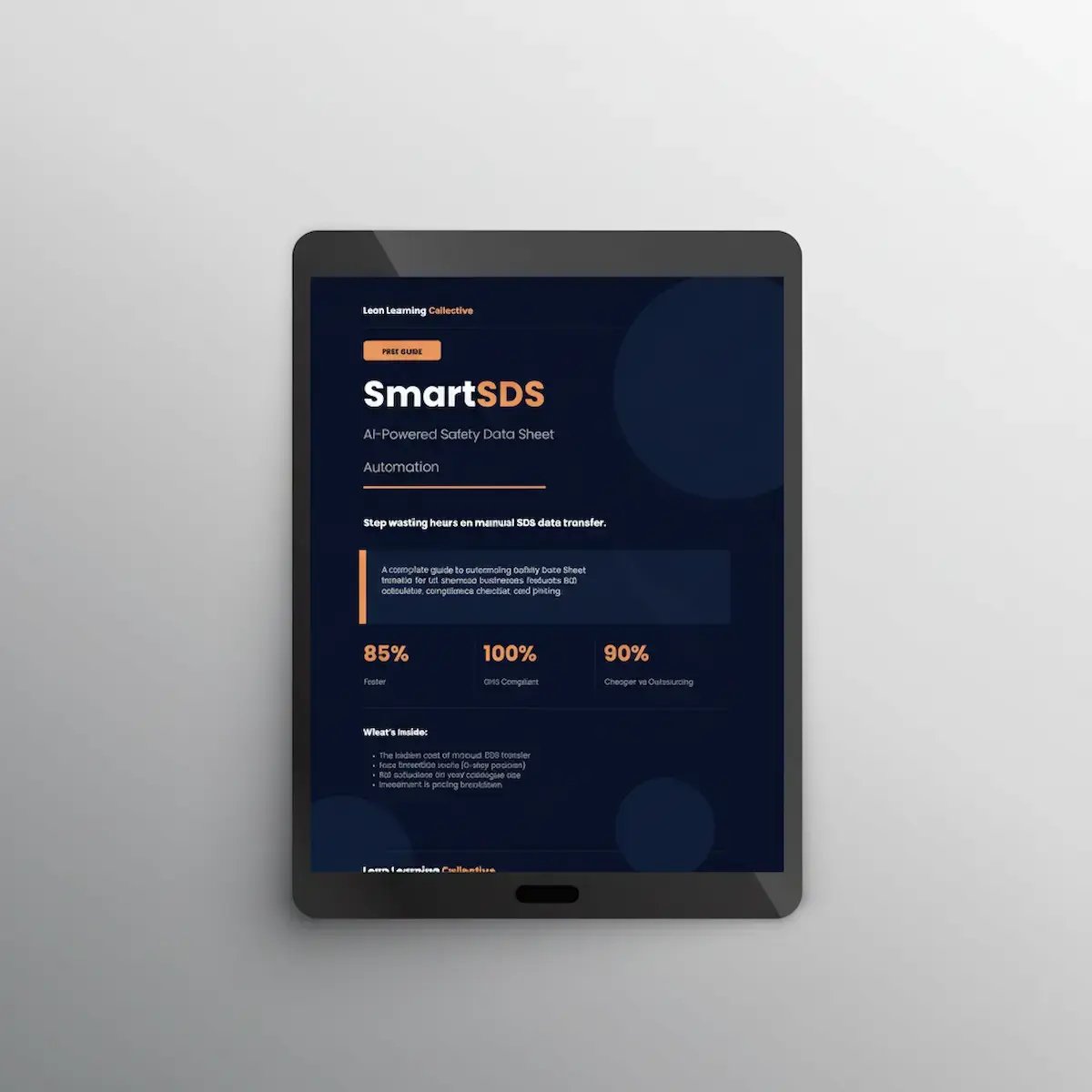
We call it SmartSDS a bespoke AI workflow built specifically around the client's branded SDS template and their suppliers' document formats.
It's important to emphasise the word "bespoke." This isn't a generic document tool. SmartSDS is configured for each client's specific template, their specific supplier formats, and their specific compliance requirements. The AI extraction layer is trained to read and interpret different SDS layouts, structures, and even languages.
The process is straightforward. The Quality Manager uploads a supplier's SDS as a PDF. The AI reads and extracts all 16 mandatory sections automatically. The extracted data is mapped directly into the company's branded template. A trained human reviewer quality checks every output document before it's released. The final branded DOCX is delivered in under five minutes.
Not 45 minutes. Five minutes.
Every output document carries the company's own name, logo, and formatting. Every output meets the mandatory 16 section GHS format required by UK REACH and GB CLP. And every output passes through human quality control because AI does the heavy lifting, but humans ensure nothing goes out unchecked.
## The Results
The impact on the first full cycle was immediate and measurable.
Processing time: 97.5 hours reduced to 10.8 hours. An 85% reduction.
Cost saving: £13,500 saved compared to outsourcing at £150 per document. The entire SmartSDS build paid for itself in the first run.
Error rate: Near zero, compared to the constant transcription mistakes inherent in manual copy & paste. The combination of AI extraction and human QC produces consistently more accurate output than manual transfer alone.
Scalability: Adding a new product to the catalogue now takes minutes, not another 45 minute manual session. The ceiling that previously limited how fast the business could onboard new products has been removed.
Compliance confidence: Every SDS in the catalogue now follows the same standardised 16 section format, produced from the same validated workflow, with the same quality controls. The version control problem, outdated supplier SDS updates sitting undetected in the system is eliminated because reprocessing is now trivial.
But the metric that mattered most to the Quality Manager wasn't on any spreadsheet.
"I've got my job back," she told me four weeks after go live. "I'm actually doing quality work now instead of data entry."
That's the real return on investment. Not just the hours saved or the pounds recovered. It's a qualified professional, someone with regulatory expertise, quality management skills, and years of industry knowledge, freed from admin work and returned to the role they were hired to do.
## Why This Problem Is So Common
Since building SmartSDS for that first client, we've discovered that this exact pain point exists across thousands of UK businesses.
Chemical distributors who rebrand supplier products under their own name need compliant SDS documents for every SKU. That's an estimated 1,500–2,000 UK companies. SME manufacturers who source raw materials and produce finished goods need branded SDS documents reflecting their own formulations, another 2,000–3,000 businesses. Private-label brands in cleaning, hygiene, and cosmetics bear the regulatory obligation as the responsible party. Construction chemical suppliers, sealants, adhesives, waterproofing compounds, face customer demands for SDS with every delivery.
In total, there are between 4,500 and 7,500 UK businesses dealing with this exact problem. Most of them are handling it the same way our first client was: manually, slowly, expensively, and with compliance risk baked into the process.
## This Is What the Lean Learning Collective Does
This story captures something fundamental about how the[Lean Learning Collective](https://www.leanlearningcollective.com/) works. We don't arrive with a pre packaged software product and try to fit your business around it. We start on the ground, inside your operations, mapping your processes, identifying your waste, and then we build the solution around your specific problem.
SmartSDS exists because a Quality Manager in a construction chemicals business was drowning in copy & paste work and nobody had thought to ask whether AI could do it instead. The technology was available. The structured nature of SDS documents made it a perfect fit. But it took an operational improvement mindset a lean consultant's instinct for spotting waste to connect the problem with the solution.
That's the Lean Learning Collective way. Lean discipline meets AI capability. We find the waste. We build the automation. We measure the result. And we make sure it sticks.
Whether it's Safety Data Sheets, email management, meeting intelligence, operational reporting, or any other process where your skilled people are buried in admin work that AI could handle the approach is always the same: practical, bespoke, measured, and sustainable.
## Want the Free SmartSDS Guide?
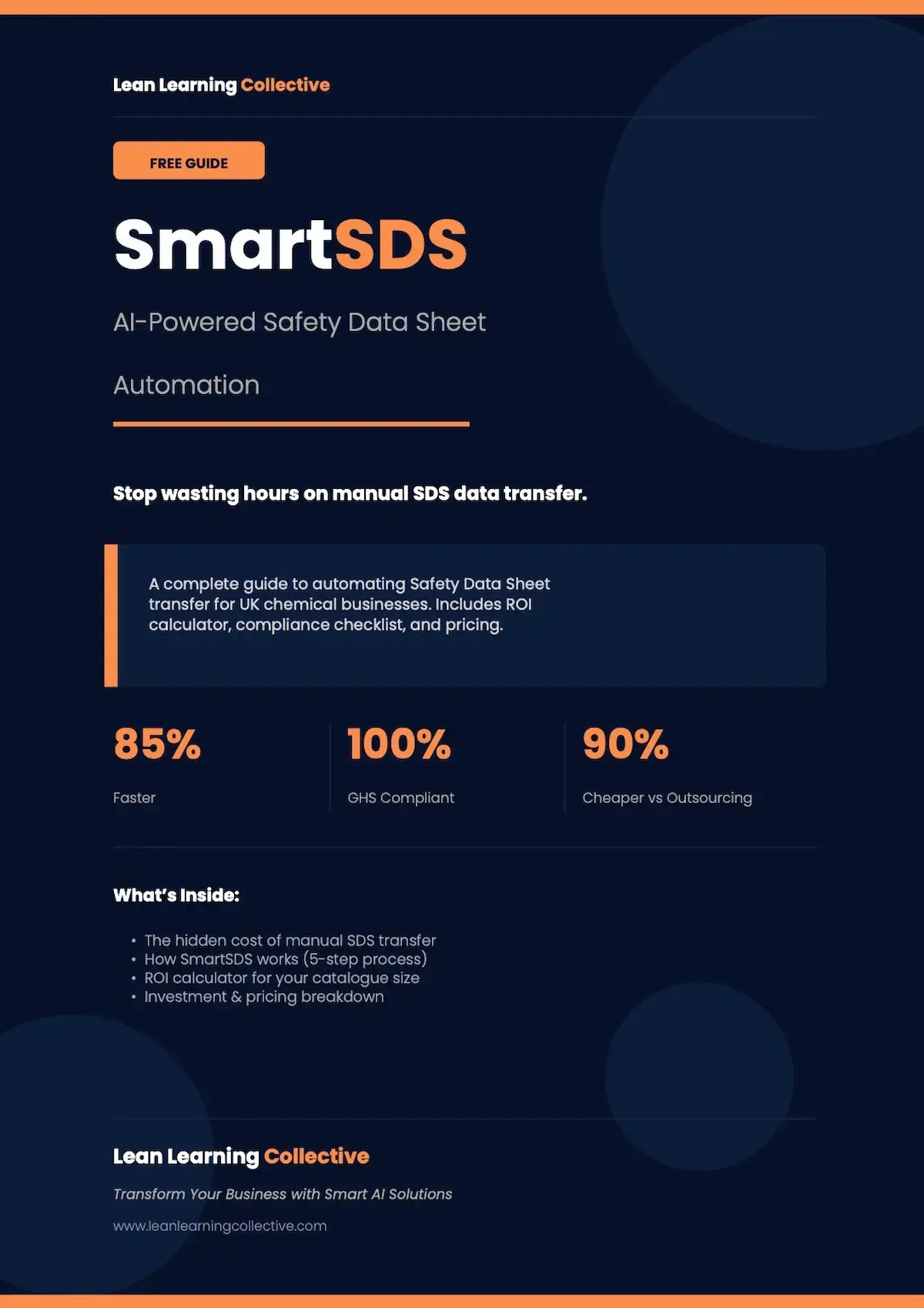
We've published a complete guide to SmartSDS, including the full 5-step process, an ROI calculator for your catalogue size, the compliance context (all 16 mandatory GHS sections explained), and our investment and pricing breakdown.
[Contact us for the free SmartSDS guide here →](https://www.leanlearningcollective.com/contact-us)
Or if you'd like to discuss how SmartSDS could work for your business, book a free 15 minute discovery call. We'll assess your catalogue, show you the process, and give you a fixed price quote, no obligation

**[Graeme Hogg](https://www.leanlearningcollective.com/blog/author/graeme-hogg)**
Apr 17, 2026, 10:49:26 AM
An Operations Consultant and Coach, Graeme lives and breathes operational excellence. Unlike typical consultants, he is known for his "boots on the ground" approach, engaging directly with teams and situations to drive meaningful change.
### Ready to Transform Your Operations?
Have a question, project idea, or just want to say hello? Reach out to our team. We’d love to hear from you.

- [Case Studies](https://www.leanlearningcollective.com/case-studies)
- [About Us](https://www.leanlearningcollective.com/about-us)
- [Who We Help](https://www.leanlearningcollective.com/who-we-help)
- [Blog](https://www.leanlearningcollective.com/blog)
- [Leana AI-Detective](https://www.leanlearningcollective.com/leana-ai-detective)
- [Smart-Stop Productivity](https://www.leanlearningcollective.com/smartstop-productivity)
- [Smart-OTIF Delivery](https://www.leanlearningcollective.com/smartotif-delivery)
- [Custom Integrations](https://www.leanlearningcollective.com/custom-workflow-integrations)
- [Book a Demo](https://www.leanlearningcollective.com/book-a-demo)
- [Instant AI Opportunity Audit](https://www.leanlearningcollective.com/ai-audit)
© 2026 Lean Learning Collective Ltd. All Rights Reserved. [Privacy Policy](https://www.leanlearningcollective.com/privacy-policy) | [Terms & Conditions](https://www.leanlearningcollective.com/terms-conditions)
-
-
-
```json
{
"@context" : "https://schema.org",
"@type" : "BlogPosting",
"author" : {
"@type" : "Person",
"name" : "Graeme Hogg",
"url" : "https://www.leanlearningcollective.com/blog/author/graeme-hogg"
},
"dateModified" : "2026-05-06T13:36:52.414Z",
"datePublished" : "2026-04-17T09:49:26.000Z",
"headline" : "How AI Cut Safety Data Sheet Processing From 97.5 Hours to 10.8 Hours (85% Faster).",
"image" : [ "https://www.leanlearningcollective.com/hubfs/SmartSDS%20Guide%20Tablet.webp" ],
"mainEntityOfPage" : {
"@id" : "https://www.leanlearningcollective.com/blog/she-was-spending-12-days-on-copy-paste.-ai-did-it-in-hours",
"@type" : "WebPage"
},
"publisher" : {
"@type" : "Organization",
"logo" : {
"@type" : "ImageObject",
"url" : "https://www.leanlearningcollective.com/hubfs/LLC-Logo-main-line-white.png"
},
"name" : "Lean Learning Collective"
}
}
```