---
title: "Paid vs Free AI: Where's the Real Value in 2026?"
description: Should I pay for ChatGPT?
image: https://www.leanlearningcollective.com/hubfs/LLC%20Blog%20Free%20vs%20Paid%20image.webp
---
[Skip to main content](https://www.leanlearningcollective.com/blog/paid-vs-free-ai-wheres-the-real-value-in-2026#main-content)
[   ](https://www.leanlearningcollective.com)
- [Who we help](https://www.leanlearningcollective.com/who-we-help)
- Show submenu for Solutions Solutions
- [Custom Integrations](https://www.leanlearningcollective.com/custom-workflow-integrations)
- [Case Studies](https://www.leanlearningcollective.com/case-studies)
- [About Us](https://www.leanlearningcollective.com/about-us)
- Show submenu for Resources Resources
- [Blog](https://www.leanlearningcollective.com/blog)
- [Instant AI Opportunity Audit](https://www.leanlearningcollective.com/ai-audit)
- [Business Growth Framework](https://www.leanlearningcollective.com/transform-your-business-framework-for-success)
- [Join the AI Community](https://www.leanlearningcollective.com/community)
Open main navigation
Close main navigation
- [Who we help](https://www.leanlearningcollective.com/who-we-help)
- Show submenu for Solutions Solutions
- Solutions
- [Custom Integrations](https://www.leanlearningcollective.com/custom-workflow-integrations)
- [Case Studies](https://www.leanlearningcollective.com/case-studies)
- [About Us](https://www.leanlearningcollective.com/about-us)
- Show submenu for Resources Resources
- Resources
- [Blog](https://www.leanlearningcollective.com/blog)
- [Instant AI Opportunity Audit](https://www.leanlearningcollective.com/ai-audit)
- [Business Growth Framework](https://www.leanlearningcollective.com/transform-your-business-framework-for-success)
- [Join the AI Community](https://www.leanlearningcollective.com/community)
- [Instant AI Audit](https://www.leanlearningcollective.com/ai-audit)
[Contact Us](https://www.leanlearningcollective.com/contact-us)
[Instant AI Audit](https://www.leanlearningcollective.com/ai-audit)
[Contact Us](https://www.leanlearningcollective.com/contact-us)
[Blog](https://www.leanlearningcollective.com/blog)
Tags
- [SmartStop](https://www.leanlearningcollective.com/blog/tag/smartstop)
- [SmartOTIF](https://www.leanlearningcollective.com/blog/tag/smartotif)
- [AI](https://www.leanlearningcollective.com/blog/tag/ai)
- [Productivity](https://www.leanlearningcollective.com/blog/tag/productivity)
- [leana](https://www.leanlearningcollective.com/blog/tag/leana)
- [FAQs](https://www.leanlearningcollective.com/blog/tag/faqs)
- [SME](https://www.leanlearningcollective.com/blog/tag/sme)
- [B2B](https://www.leanlearningcollective.com/blog/tag/b2b)
- [Coaching](https://www.leanlearningcollective.com/blog/tag/coaching)
- [Krones Labeller](https://www.leanlearningcollective.com/blog/tag/krones-labeller)
- [SmartStop](https://www.leanlearningcollective.com/blog/tag/smartstop)
- [SmartOTIF](https://www.leanlearningcollective.com/blog/tag/smartotif)
- [AI](https://www.leanlearningcollective.com/blog/tag/ai)
- [Productivity](https://www.leanlearningcollective.com/blog/tag/productivity)
- [leana](https://www.leanlearningcollective.com/blog/tag/leana)
- [FAQs](https://www.leanlearningcollective.com/blog/tag/faqs)
- [SME](https://www.leanlearningcollective.com/blog/tag/sme)
- [B2B](https://www.leanlearningcollective.com/blog/tag/b2b)
- [Coaching](https://www.leanlearningcollective.com/blog/tag/coaching)
- [Krones Labeller](https://www.leanlearningcollective.com/blog/tag/krones-labeller)
# Paid vs Free AI: Where's the Real Value in 2026?

by [Graeme Hogg](https://www.leanlearningcollective.com/blog/author/graeme-hogg)
Jul 28, 2026, 9:24:35 AM
“Should I pay for ChatGPT, or is the free version good enough?”
It is one of the questions we at the Lean Learning Collective get asked most often by the SME leaders we work with. It sounds simple. It is not, because the honest answer depends entirely on how you actually work. A sole trader writing the occasional email has very different needs from an operations director using AI to interrogate data every day. So rather than give you a glib “yes” or “no”, let me give you the version I give clients: a way of thinking about the decision that you can apply to almost any AI tool, not just ChatGPT.
## **The free tier is genuinely good now**
This is the part that surprises people. The free version of ChatGPT in 2026 is not a crippled demo designed to nag you into upgrading. You get web browsing for current information, file and image uploads, image analysis, and even some image generation. For drafting emails, knocking out quick summaries, and handling one-off tasks, it does the job well.
If you are a light or occasional user, you may genuinely never need to pay a penny. That is worth saying plainly, because a great deal of the advice floating around online is quietly trying to sell you a subscription you do not need. The free tier is a real, working tool, not bait.
### **So where does ‘free’ start costing you?**
In one word: **the ceiling.**
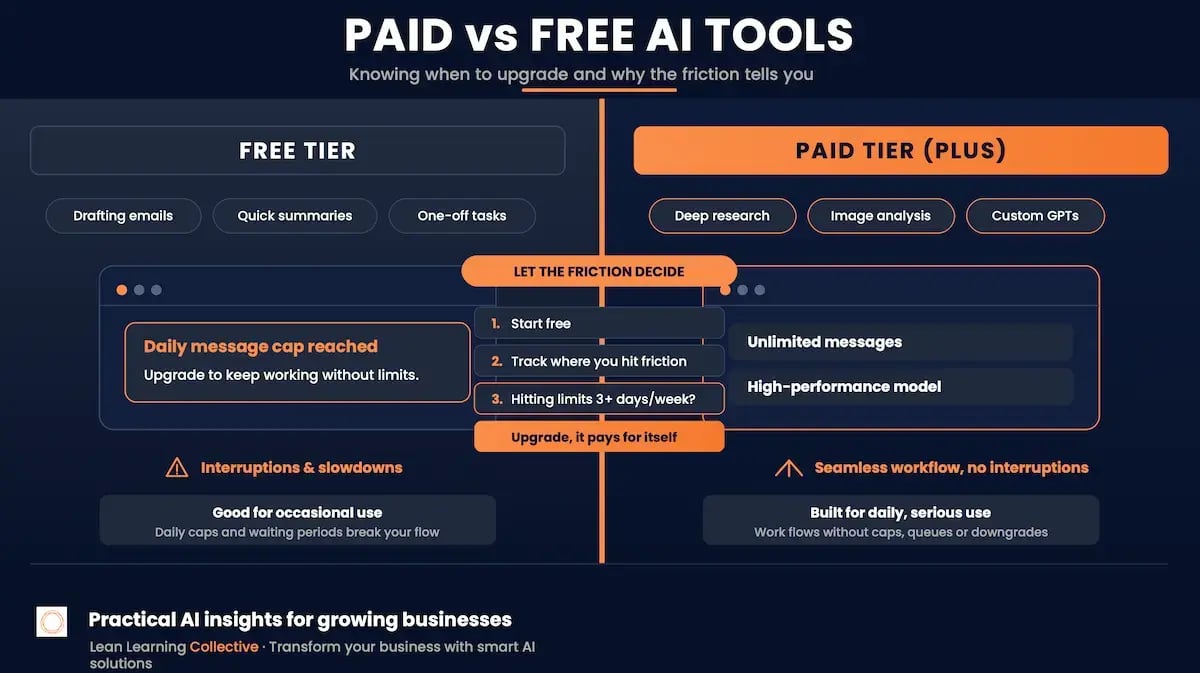
On a busy Tuesday morning you will hit the message cap, get quietly bumped down to a weaker, faster model, and your train of thought stalls. For someone using AI casually, that is a minor annoyance. For anyone using it as a **core work tool**, that friction is genuinely expensive, not in pounds, but in lost time, broken concentration, and the cost of switching context back and forth.
There is a second, subtler cost. The free tier defaults to a lighter model that is faster but weaker at reasoning. We once watched it produce a beautiful-looking budget breakdown that was simply wrong, the arithmetic was off by a few hundred pounds. The stronger model caught it. When the stakes are low, that does not matter. When you are making decisions off the output, it matters a great deal.
***The trap is not paying too much for AI. It is paying with your time and your accuracy and not noticing you are doing it.***
## **What you are actually buying when you upgrade**
The paid tier (around £16–£20 a month) is not really buying you “a chatbot.” It is buying you three things that matter for serious work:
- **The better reasoning model** — noticeably stronger on anything involving logic, numbers, or multi-step thinking. This is the single biggest difference, and the one people underestimate.
- **No interruptions** — you stay in flow instead of waiting for rate limits to reset. For deep work sessions, this alone can justify the cost.
- **Power tools** — deep research that compiles findings across many sources, larger context windows for big documents, and early access to new features.
- **Run free for a full working week** and do not change how you work. Use it for everything you normally would.
- **Keep a tally** of every time you hit a limit, get downgraded to a weaker model, or wait for a reset. A note on your phone is enough.
- **Add up the friction** at the end of the week. If it cost you more than an hour in total, the paid plan has almost certainly already paid for itself.
One business owner we work with tracked his usage for a week before deciding. He was hitting the limit four days out of five.
He told me the upgrade paid for itself in the first week, purely from not waiting for limits to clear and not redoing work the weaker model had fumbled.
### **It is no longer a simple free or paid choice**
One thing that confuses people in 2026 is that the old binary, free, or the £20 plan has quietly become a ladder. There is now a cheaper mid-tier sitting between them, aimed at people who like the free experience but keep bumping into the usage limits. It gives you more volume without the full feature set of the top plan.
For a lot of small-business users, that middle rung is the sweet spot: enough headroom to work without interruption, without paying for research and reasoning tools they will rarely touch.
It is also worth knowing that the free tier in some regions now carries advertising. That is not necessarily a dealbreaker, but it is a sign of the direction of travel: the genuinely unlimited, distraction-free experience is increasingly the thing you pay for. Factor that into your decision rather than being surprised by it later.
## **A simple way to decide, whatever the tool**
Because this same question comes up for every AI subscription, not just ChatGPT, it helps to have a repeatable test. Here is the one I use with clients:
This turns an emotional decision “am I the kind of person who pays for AI?”
Into a simple one grounded in evidence. You are not buying status or keeping up with anyone. You are buying back time you can measure.
### **THE LEAN TAKE**
**Start free. Track how often you hit the wall over one working week.** If it is three or more days out of five, upgrade. Let the friction make the decision for you, not the marketing, and not the fear of missing out. The right plan is the one your actual usage points to.
The same logic applies to almost every AI subscription you will weigh up this year. Let the pain point justify the spend.
At the [Lean Learning Collective](https://www.leanlearningcollective.com), we help SMEs put AI to work without the hype. Explore [who we help](https://www.leanlearningcollective.com/who-we-help), try our free [Instant AI Opportunity Audit](https://www.leanlearningcollective.com/ai-audit), or [get in touch](https://www.leanlearningcollective.com/contact-us) to talk it through.
**👉 Follow the Lean Learning Collective Blogs for more insights.**

**[Graeme Hogg](https://www.leanlearningcollective.com/blog/author/graeme-hogg)**
Jul 28, 2026, 9:24:35 AM
An Operations Consultant and Coach, Graeme lives and breathes operational excellence. Unlike typical consultants, he is known for his "boots on the ground" approach, engaging directly with teams and situations to drive meaningful change.
### Ready to Transform Your Operations?
Have a question, project idea, or just want to say hello? Reach out to our team. We’d love to hear from you.

- [Case Studies](https://www.leanlearningcollective.com/case-studies)
- [About Us](https://www.leanlearningcollective.com/about-us)
- [Who We Help](https://www.leanlearningcollective.com/who-we-help)
- [Blog](https://www.leanlearningcollective.com/blog)
- [Leana AI-Detective](https://www.leanlearningcollective.com/leana-ai-detective)
- [Smart-Stop Productivity](https://www.leanlearningcollective.com/smartstop-productivity)
- [Smart-OTIF Delivery](https://www.leanlearningcollective.com/smartotif-delivery)
- [Custom Integrations](https://www.leanlearningcollective.com/custom-workflow-integrations)
- [Book a Demo](https://www.leanlearningcollective.com/book-a-demo)
- [Instant AI Opportunity Audit](https://www.leanlearningcollective.com/ai-audit)
© 2026 Lean Learning Collective Ltd. All Rights Reserved. [Privacy Policy](https://www.leanlearningcollective.com/privacy-policy) | [Terms & Conditions](https://www.leanlearningcollective.com/terms-conditions)
-
-
-
```json
{
"@context" : "https://schema.org",
"@type" : "BlogPosting",
"author" : {
"@type" : "Person",
"name" : "Graeme Hogg",
"url" : "https://www.leanlearningcollective.com/blog/author/graeme-hogg"
},
"dateModified" : "2026-07-28T08:24:35.270Z",
"datePublished" : "2026-07-28T08:24:35.000Z",
"headline" : "Paid vs Free AI: Where's the Real Value in 2026?",
"image" : [ "https://www.leanlearningcollective.com/hubfs/LLC%20Blog%20Free%20vs%20Paid%20image.webp" ],
"mainEntityOfPage" : {
"@id" : "https://www.leanlearningcollective.com/blog/paid-vs-free-ai-wheres-the-real-value-in-2026",
"@type" : "WebPage"
},
"publisher" : {
"@type" : "Organization",
"logo" : {
"@type" : "ImageObject",
"url" : "https://www.leanlearningcollective.com/hubfs/LLC-Logo-main-line-white.png"
},
"name" : "Lean Learning Collective"
}
}
```